
AI Grid Orchestration for Telcos with stack8s

Telcos no longer run AI in one neat data centre. They run it across towers, central offices, regional sites, and cloud zones. That spread creates a hard problem: how do you manage all of it as one platform without losing control of latency, cost, GPUs, or data rules?
That is where AI Grid Orchestration fits. It places workloads where they make the most sense, then keeps policy, scaling, and recovery aligned across the estate. NVIDIA AI Grid Orchestration is now a clear reference point for this model, as recent telecom AI grid deployments show. For telcos that also need sovereign control, stack8s project AiK Edge (part of the NVIDIA Inception Program) offers a GLOBAL Kubernetes orchestrator to run mixed infrastructure through one control plane - any substrate, stretch and scale anywhere (literally).
Inside the AI Grid: How Telecom Networks Are Becoming Distributed AI Clouds
What an AI Grid actually looks like inside a telecom network — and why stack8s is built to orchestrate it.
Rethinking the Telco Edge
The opportunity here becomes easier to grasp once you stop picturing "the telco edge" as a single place.
A telecom operator typically runs:
- Thousands of radio sites
- Hundreds of aggregation or central-office locations
- A smaller number of regional data centres
- Connections into public or sovereign cloud infrastructure
Each layer has its own mix of latency, power, cooling, GPU capacity, and cost.
An AI Grid turns those separate locations into tiers of one schedulable inference platform.
At a power-constrained cell site, a smaller accelerator can handle immediate vision, speech, or physical-AI inference — NVIDIA positions its RTX PRO 4500 Blackwell Server Edition (32 GB GPU memory, 165 W max) for exactly this. At a larger mobile switching office or metro edge facility, the heavier-duty RTX PRO 6000 Blackwell Server Edition (96 GB ECC GDDR7) takes over. Further upstream, regional GPU clusters handle workloads that favor throughput and scale over rock-bottom latency.
This is where stack8s comes in: making these different locations behave as one schedulable AI infrastructure layer.
A workload doesn't just ask for "a GPU." It expresses intent:
"Run this model inside the UK, within a defined latency target, on an available NVIDIA-compatible GPU, close to the subscriber — while keeping enough capacity available for failover."
stack8s's orchestration layer then decides whether that workload belongs at the cell edge, the nearest metro location, another telco facility, or a larger regional AI cluster.
Why the RTX PRO 6000 Is the Interesting Piece for Metro Edge
The RTX PRO 6000 Blackwell Server Edition earns its place at central offices, aggregation sites, and mobile switching offices because its 96 GB of GPU memory lets a relatively small physical server run serious generative-AI workloads. NVIDIA's NIM software stack already supports Llama-family models on it — including Llama 3.3 70B deployments under specific inference configurations.
The practical effect: instead of routing every AI request from a subscriber in Manchester, Birmingham, or Glasgow all the way back to one large GPU cluster in London, frequently used models can simply live on GPU infrastructure closer to the subscriber.
A metro node might keep resident locally:
- A customer-service voice model
- An enterprise RAG model
- A vision-language model
- Several smaller specialist models
Less-used or very large models stay in the regional AI factory. The result is a grid that's hierarchical, not just distributed:
Cell Site → Metro Edge → Regional AI Factory → Cloud
stack8s maintains one common policy and orchestration plane across all four tiers.
Why Edge Inference Matters for TTFT
For generative AI, "latency" isn't one number. The metric that actually shapes user experience is Time to First Token (TTFT) — how long someone waits before the AI starts responding.
NVIDIA breaks client-side TTFT down into: network round-trip time, GPU queueing, tokenization or speech processing, model prefill and initial decode, and (for voice) voice-activity detection. Moving inference closer to the user won't eliminate model-compute time, but it directly cuts network RTT — and, when requests are intelligently distributed, it reduces queueing too.
A concrete example: if reaching a centralized AI region eats 50 ms of your latency budget round-trip, while a metro-edge endpoint needs only 10 ms, edge placement just handed back 40 ms before the model has done any work at all. For a conversational target of ~500 ms, that's a meaningful chunk of the budget.
More importantly, a distributed grid absorbs geographically concentrated traffic bursts instead of funneling every request into the same GPU queue.
Proof point: Comcast's distributed voice AI test
This isn't just architectural theory anymore.
In a benchmark published by NVIDIA, Comcast compared the same Personal AI voice small-language model running on four RTX PRO 6000 GPUs in two configurations: the GPUs concentrated into a centralized cluster, and the GPUs distributed across four AI Grid locations.
The results, at a glance:
| Metric | Result |
|---|---|
| Latency target | Sub-500 ms end-to-end conversational latency maintained across tested traffic scenarios, including burst conditions |
| Burst throughput | 42,362 tokens per second — an 80.9% increase over baseline |
| Cost per token (baseline) | 52.8% lower |
| Cost per token (burst) | 76.1% lower |
Actual production results will naturally vary by network, model, and traffic pattern.
The lesson isn't "own more distributed GPUs" — it's that the value comes from deciding which GPU answers each request.
Six Ways This Plays Out in the Real World
1. The telco becomes the platform for real-time voice AI
Picture an enterprise Voice AI service: a customer calls a retailer, bank, airline, or public-sector organization. Instead of streaming the whole interaction to a distant hyperscale region, speech recognition and the conversational model run at the nearest telco metro location — combining local voice-activity detection, speech recognition, a small-to-medium language model, retrieval against enterprise data, and text-to-speech, all inside the operator's own network.
stack8s provides the placement layer: deploying inference services across locations, watching GPU utilization and latency, keeping models where demand exists, and overflowing requests to the next available site when a local pool saturates.
The telco effectively starts selling Tokens-as-a-Service at the network edge, not just connectivity.
2. Smart cities without streaming every camera to the cloud
Sending thousands of continuous high-res camera feeds to one centralized cloud burns enormous backhaul capacity and raises data-governance concerns. Instead, 5G-connected cameras stream to nearby GPU infrastructure, where local vision models handle detection, tracking, summarization, and event recognition — only events, metadata, or select clips travel upstream.
NVIDIA describes this using Metropolis running on AI Grid nodes, where local processing can anonymize data and trigger actions before anything reaches central systems. T-Mobile is already working with NVIDIA and AI developers on this model, with current pilots covering smart-city agents, utility inspection, facility management, and industrial-safety applications across distributed edge infrastructure — targeting five-times faster incident response in San Jose.
5G cameras/sensors → nearest edge GPU → local inference → events/metadata → city operations platform
A central stack8s control plane deploys and upgrades the models while the raw data stays local.
3. Utilities, railways, and industrial sites
A drone inspecting a power line sends imagery over 5G to a nearby inference node, where vision models flag damaged equipment, corrosion, vegetation encroachment, or thermal anomalies in real time.
T-Mobile's AI-RAN programme includes work with Levatas and Skydio on utility inspections, targeting five-times faster detection and resolution of anomalies such as leaning power poles, corrosion, and thermal hotspots. It's also working with Fogsphere on industrial safety agents that identify hazardous conditions including workers underneath suspended loads and hydrocarbon spills.
The commercial shift: instead of selling a SIM card and a connection, operators sell connectivity + local GPU inference + sovereign data processing + AI application runtime. The network becomes part of the customer's own AI infrastructure.
4. Autonomous vehicles and robotics
Physical AI raises the latency stakes even further. A robot or delivery vehicle handles basic perception locally but offloads heavier reasoning to the network — the telco edge becomes an extension of the robot's own compute.
SoftBank has demonstrated this in its AI-RAN work with NVIDIA, running carrier-grade 5G and AI inference on common accelerated infrastructure during an outdoor trial in Kanagawa — including autonomous-vehicle remote support, robotics control, and multimodal retrieval-based AI at the edge.
This is the case that shows AI-RAN isn't just "AI to optimize the network" — it's an AI compute marketplace attached to the mobile network itself. A delivery robot can connect to the closest edge node in one neighborhood and get seamlessly handed off to another as it moves — same application, same security policy, same model, different infrastructure underneath.
5. Private and sovereign enterprise LLMs at the telco edge
No robots or cameras required for this one. Banks, hospitals, government bodies, law firms, and industrial customers often want generative AI without sending prompts, documents, or logs to an overseas public AI service.
An RTX PRO 6000 metro site can host specialist or substantial LLMs close to the enterprise customer, with larger models routed to regional clusters only when needed. A stack8s policy might read:
"Customer A's data must remain in the United Kingdom. Prefer Manchester Edge. Overflow to Birmingham. Use London AI Factory only if local TTFT or capacity thresholds can't be met. Never route outside the jurisdiction."
That turns sovereignty into a scheduling property, not a hand-built environment.
6. Turning spare network infrastructure into an inference business
Telcos already have what AI companies are trying to build: thousands of secure, powered, connected physical sites close to users.
SoftBank's live AI-RAN trial demonstrated concurrent 5G and AI inference on accelerated infrastructure, and SoftBank and NVIDIA are explicitly exploring the commercial opportunity of making unused accelerated capacity available for third-party AI workloads — published figures are estimates, but the principle holds: spare distributed compute can become sellable inference capacity.
Akamai is running a similar play at internet-edge scale: in March 2026 it announced AI Grid orchestration across more than 4,400 edge locations, with thousands of RTX PRO 6000 Blackwell Server Edition GPUs deployed across its infrastructure, routing workloads between edge, regional, and core capacity by latency, performance, and cost.
For a telco, the equivalent is compelling: instead of 50 or 500 isolated GPU servers, stack8s exposes them as one logical capacity pool.
Where stack8s Fits
The division of labor is clean:
- NVIDIA provides the accelerated computing, inference software, and emerging AI-RAN architecture.
- The telecom operator provides the network, spectrum, sites, power, and customer relationships.
- stack8s provides the infrastructure-independent orchestration layer connecting the two.
The platform maintains a live inventory of GPU resources and continuously weighs GPU type, GPU memory, model availability, network latency, jurisdiction, site health, utilization, and customer policy when placing a workload:
- Run locally if the model is available and the latency target can be met.
- Overflow to the nearest metro GPU pool if cell-site capacity is constrained.
- Use the regional AI factory for larger reasoning models.
- Use approved cloud capacity only when policy permits it.
And if a site fails, the service gets recreated or rerouted elsewhere — without the customer ever needing to understand the underlying telecom topology.
That's the real difference between a pile of edge servers and an AI Grid.
From Connectivity Provider to Distributed AI Cloud
The individual GPU is useful. The distributed network is valuable. But the orchestration layer is what turns thousands of geographically scattered GPUs into an actual platform.
Cell sites bring proximity. Metro sites bring substantial inference capacity. Regional data centres bring scale. The mobile network ties the physical world to all three — and with AI Grid orchestration, none of it has to operate as separate islands anymore.
It can become one sovereign, policy-controlled, programmable AI infrastructure layer.
That's the opportunity stack8s is built for: turning distributed telecom infrastructure into a unified AI compute fabric, where models and inference workloads automatically run in the best available location.
What AI Grid Orchestration means for a telco edge network
In plain English, AI Grid Orchestration is the control layer for distributed AI. It does far more than push an app into production. It decides where a model should run, scales it when demand rises, applies policy, watches health, and restores service after faults. In a telco, that spans 5G edge nodes, points of presence, central offices, and regional data centres. Think of it like air traffic control for AI, because every workload has a best route, a best landing spot, and rules it must follow.
From scattered edge sites to one usable AI fabric
Without orchestration, each site becomes its own mini-project. One location has spare GPUs, another has better latency, and a third must keep data in-region. Soon, operations teams are juggling exceptions instead of running a platform. AI Grid Orchestration turns that patchwork into one operating model.
Placement becomes policy-led. A workload can stay near the user for response speed, move to a regional hub for lower cost, or avoid a degraded site if health drops. As a result, telcos can support low-latency AI services, automate network decisions, and launch enterprise edge offers without treating every location as a special case.
The biggest edge AI problems telcos face, and how stack8s helps solve them
The edge sounds simple until production starts. Then the real issues appear: tight latency targets, costly GPUs, local data rules, mixed hardware, and too many tools. Telco teams don't need more moving parts. They need one way to run them.
Keeping latency low without wasting GPUs
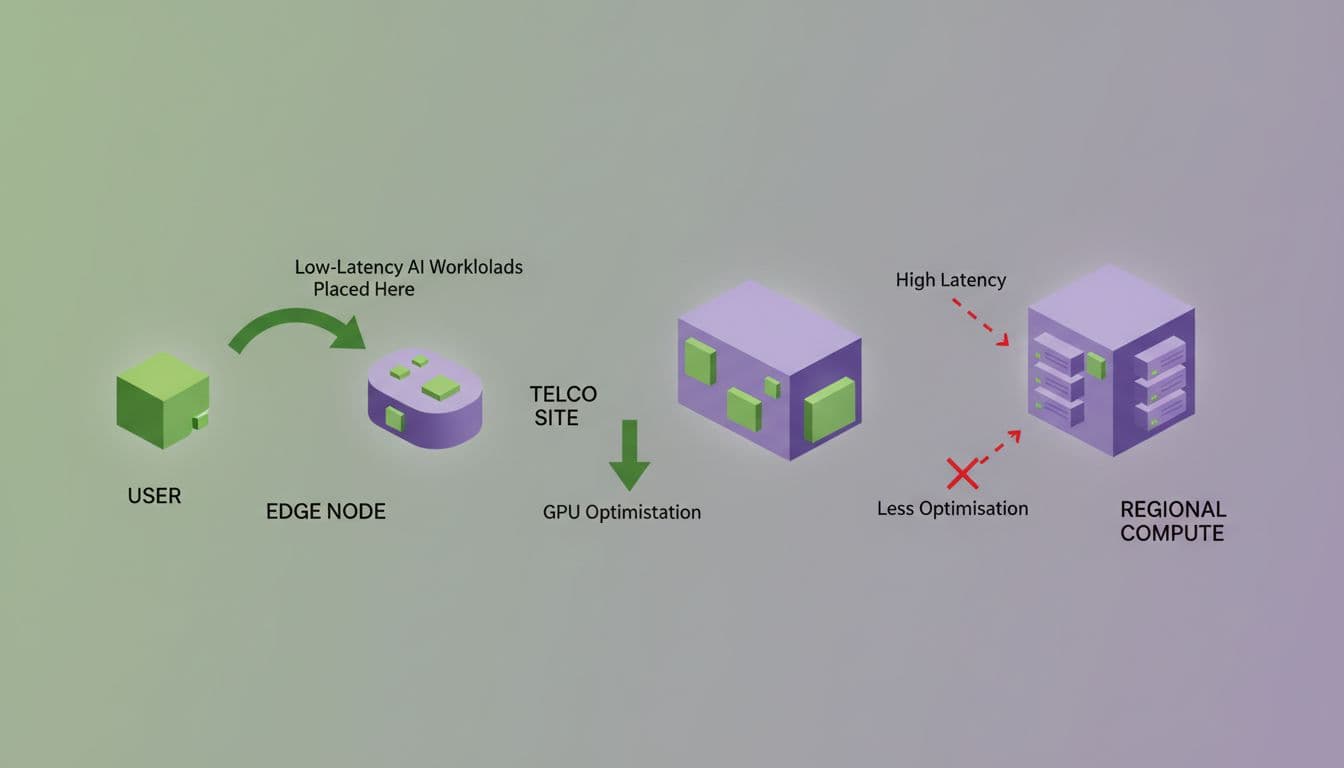
Some AI jobs must stay close to users. Voice services, video analytics, fraud checks, and network response loops can't wait for a distant region. Yet other work, such as batch inference, retraining steps, or offline analysis, can run farther away for less money.
Stack8s helps place and move workloads across cloud, on-prem, and edge nodes under one control plane. So teams can keep millisecond-sensitive inference local, while shifting less urgent work to cheaper capacity. That improves GPU use and lowers spend. It also matches the direction seen in Akamai's AI Grid rollout, where distributed inference is routed across edge, regional, and core locations.
Meeting sovereignty, security, and multi-tenant needs
Telcos often carry several trust zones at once. Internal network teams need protected access. Enterprise customers want private AI. Partners may need isolated projects on the same platform. At the same time, data may need to stay in-country or within a named region.
That is where stack8s has a strong fit. Its sovereign deployment model, private registries, regional redundancy, and zero-trust posture support policy-led operations. In other words, telcos can host private AI services without giving up control of where data, models, and logs live.
Running thousands of sites without operational sprawl
Scale breaks manual processes first. Updates drift. Patches land unevenly. One vendor exposes one dashboard, another exposes three, and outage recovery becomes slower than it should be. Mixed hardware makes it worse.
If every edge site behaves differently, the edge never becomes a platform.
Stack8s leans on Kubernetes, GitOps, and a single portal to standardise roll-outs, patching, monitoring, and recovery. That gives telcos a more consistent way to manage varied edge footprints, even when the sites and suppliers don't match.
Why stack8s AiK Edge is a strong fit for AI Grid Orchestration in telco environments
A telco AI platform has to do two jobs at once. It must be flexible for platform teams, yet controlled enough for security, policy, and uptime. Stack8s fits because it joins sovereign cloud control with Kubernetes orchestration and AI-ready infrastructure support.
One control plane across cloud, on-prem, and far-edge sites
The stack8s Spine fabric links compute across more than one provider into a unified Kubernetes control plane. That means telcos can provision GPUs, CPUs, and storage across public cloud, private infrastructure, and far-edge sites, then move workloads without lock-in. The stack8s Network Fabric spans across 30+ Clouds and 1000 Datacenters across the globe and is built for exactly that kind of distributed control.
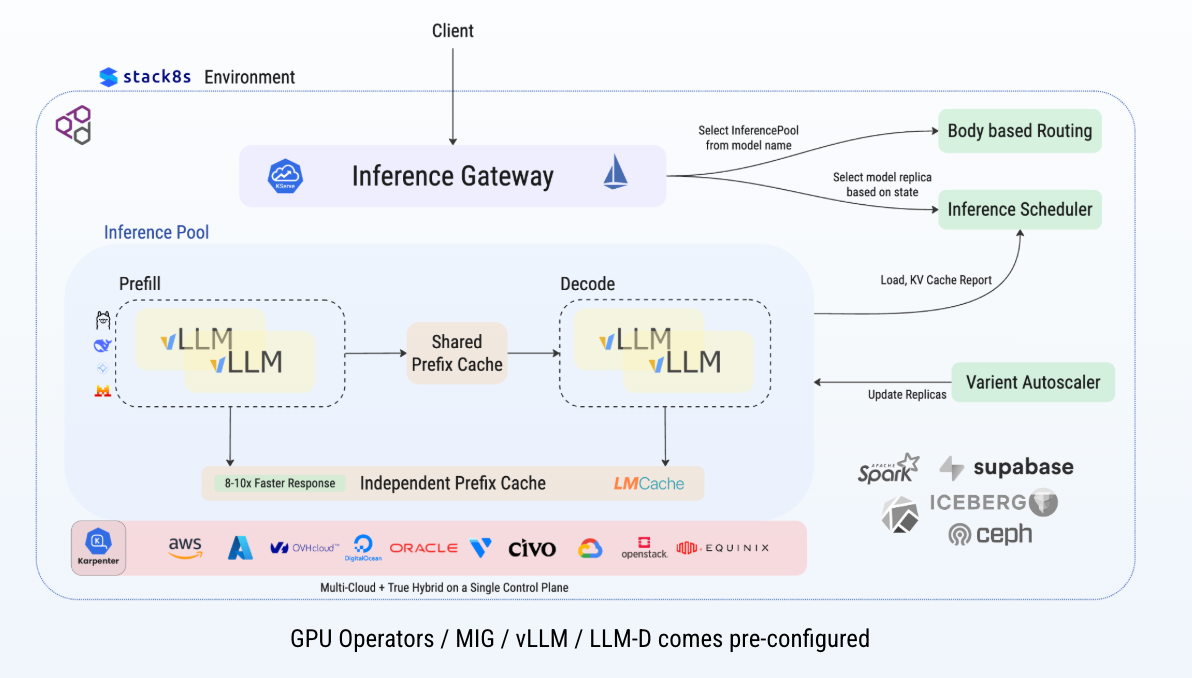
Most telcos already own a mixed estate. They can't stop everything and re-platform from scratch. Stack8s meets that reality with vanilla Kubernetes, hybrid clustering, and vendor flexibility across 15+ cloud and edge providers. So the platform works with what operators already have, while still giving them one place to manage projects, clusters, and AI components.
A practical path from infrastructure to revenue-ready AI services
This is where orchestration becomes commercial. Telcos can stand up private LLM services, video analytics, AI agents for network operations, and enterprise edge offers on the same base platform. The mix of stack8s and NVIDIA-style AI Grid thinking helps them build faster, keep control, and waste fewer resources.
Conclusion
The hard part of telco edge AI is not adding more compute. It's managing compute, policy, security, and placement together. NVIDIA AI Grid Orchestration shows where the market is heading, because distributed inference now needs smarter control across hubs and edge sites. Stack8s offers a practical way to do that now, with a sovereign, Kubernetes-based control plane across cloud, on-prem, and far-edge infrastructure. For telcos, that turns a messy edge estate into a usable AI platform, one that supports both internal operations and new customer-facing services.